


Face Recognition Door Lock vs Fingerprint vs Palm Vein: 5 Powerful Reasons to Upgrade in 2026

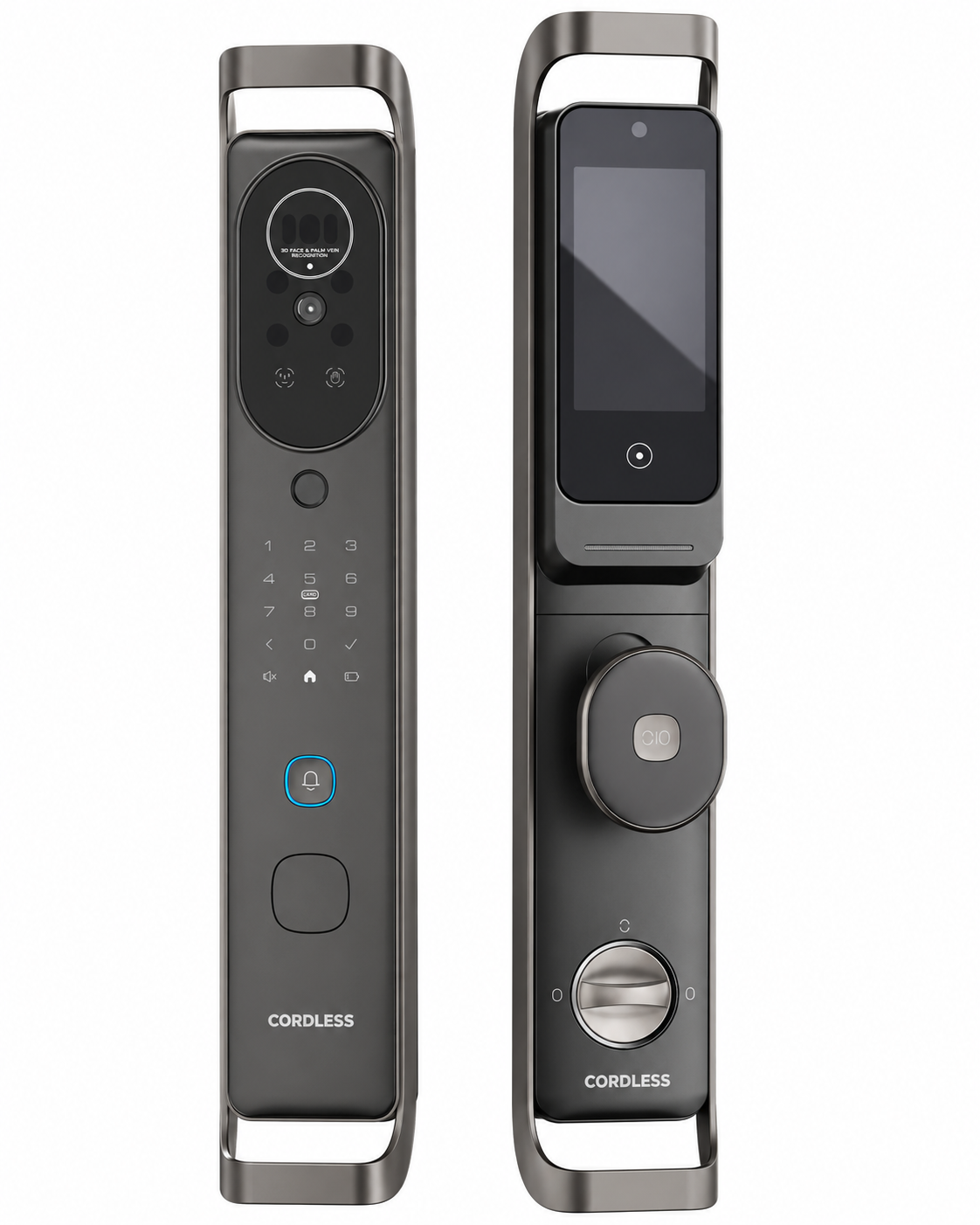
A face recognition door lock lets you walk up to your front door and step inside without touching anything: no key, no code, no finger on a sensor. In 2026 it has become the most requested feature among homeowners in Egypt who are upgrading their entrance. But is a face recognition door lock really better than a fingerprint lock, and where does the newer palm vein technology fit in? This guide compares all three unlocking methods honestly, so you can choose the right lock for your family, your door and your budget.
We will explain how each technology works, where each one shines, where each one struggles, and which Cordless smart locks combine them in a single device. By the end, you will know exactly which features to look for before you buy.
What Is a Face Recognition Door Lock?
A face recognition door lock is a smart lock with a built-in camera module that identifies registered users by the shape of their face. When you approach the door, the lock wakes up, scans your face in under a second and unlocks automatically if it finds a match. Most models also keep backup methods such as a PIN code, a magnetic card, a mobile app and a mechanical emergency key.
There are two very different kinds of facial recognition used in door locks, and the difference matters a lot for security:
- 2D face recognition uses a normal camera image. It is cheaper, but a good photo or video of the owner can sometimes fool it.
- 3D face recognition uses structured light or depth sensing to build a three-dimensional map of your face. It measures depth, contours and distance, so a flat photo or a phone screen cannot unlock the door.
Every Cordless face recognition door lock uses 3D recognition. Models such as the CL-L2 use 3D structured light specifically to prevent photo and video spoofing. If you want to read more about the science behind it, the facial recognition system overview on Wikipedia is a useful starting point.
How Does a Face Recognition Door Lock Work?
The process is simple from the outside, but there is clever engineering inside. Here is what happens in the second or so between you reaching the door and the bolt retracting:
- Wake-up: a proximity or motion sensor detects that someone is standing in front of the lock and powers up the camera module. This saves battery when nobody is around.
- Capture: an infrared projector and camera capture the face, even at night or in a dark corridor.
- Liveness check: the lock checks depth information to confirm it is looking at a real, three-dimensional person and not a picture.
- Matching: the face template is compared with the users stored in the lock’s memory. Templates are mathematical descriptions, not ordinary photos.
- Unlock: if the match passes, the motor retracts the bolt. On fully automatic models such as the CL-S16, the lock also re-locks itself when the door closes.
Because there is nothing to press, a face recognition door lock is especially practical when your hands are full with shopping bags, a baby or a suitcase.
Face Recognition vs Fingerprint vs Palm Vein: Quick Comparison
Before going deeper, here is a quick side-by-side view of the three biometric methods you will find on modern smart locks.
| Feature | 3D Face Recognition | Fingerprint | Palm Vein |
|---|---|---|---|
| Touch needed | No | Yes | No (hover the hand) |
| Speed | About 1 second | Under 1 second | About 1 second |
| Works with wet or dusty hands | Yes | Sometimes fails | Yes |
| Hard to copy | High (3D depth) | Medium | Very high (veins are under the skin) |
| Best for | Hands-free daily entry | Budget locks, quick access | Maximum security, elderly users |
| Battery use | Higher | Low | Medium |
As you can see, no single method wins every category. That is exactly why the best locks now combine two or three of them.
Fingerprint Locks: Fast, Familiar and Affordable
Fingerprint recognition is the technology most people already know from their phones. A capacitive or optical sensor reads the ridges of your finger and compares them with stored templates. It is fast, uses very little power and keeps the price of the lock low.
Fingerprint locks are a great choice when budget matters most. The G-14, for example, combines fingerprint, PIN, card, app and a mechanical key, making it a solid entry-level option for apartments and offices.
However, fingerprints have some weaknesses that matter in daily life:
- Wet, oily, dusty or cut fingers can cause failed reads.
- Elderly family members and children sometimes have faint fingerprints that are harder to register.
- Fingerprints are left on surfaces, so in theory they can be lifted and copied by a determined attacker.
- You still need a free hand to touch the sensor.
For many families, fingerprint access is perfect as a backup method, while a face recognition door lock handles the everyday hands-free entry.
Palm Vein Recognition: The Most Secure Biometric
Palm vein recognition is the newest technology on the list and arguably the most secure. Instead of reading the surface of your skin, the sensor shines near-infrared light into your palm. The hemoglobin in your blood absorbs this light, revealing the unique pattern of veins under the skin. You can learn more about the method on the vein matching page on Wikipedia.
Why does this matter? Because your vein pattern is inside your body. It cannot be photographed from across the street or lifted from a glass. It also does not change with age, scratches or dry skin, which makes it ideal for parents and grandparents.
Palm vein is also touch-free: you simply hold your hand a few centimeters in front of the sensor. Cordless locks such as the CL-07, CL-08, CL-Space and CL-L2 include palm vein recognition alongside face recognition.
5 Reasons a Face Recognition Door Lock Is Worth It
1. Truly Hands-Free Entry
This is the biggest advantage. Carrying groceries, holding a child or pulling a suitcase? A face recognition door lock opens without you putting anything down. Once you get used to it, going back to keys feels strange.
2. Strong Protection Against Spoofing
With 3D depth sensing and liveness detection, a quality face recognition door lock cannot be opened with a printed photo or a video played on a phone. This closes the main loophole of cheaper 2D cameras.
3. Works for the Whole Family
Children who forget keys, elderly parents with faint fingerprints and family members with busy hands can all get in easily. You can usually register many faces and remove a user from the app or the lock menu in seconds.
4. Built-In Camera and Visitor Video
Because a face recognition door lock already has camera hardware, many models also capture visitors and support a two-way video call through the app. The CL-G40, for instance, combines an external camera, an internal screen and 2-way video with 3D face, palm vein and fingerprint unlocking.
5. Better Hygiene
Touch-free entry means fewer shared surfaces. In busy homes, clinics and offices this is a small but real benefit, and it is one more reason touchless methods are growing quickly.
Possible Downsides to Consider
No technology is perfect, and an honest buying decision should consider the limits too:
- Battery consumption: cameras and infrared projectors use more power than a fingerprint sensor. Look for large rechargeable batteries or dual-battery designs, such as the 2 × 3500 mAh system in the CL-L2.
- Price: a 3D face recognition door lock costs more than a basic fingerprint model.
- Identical twins: very similar faces can confuse some systems. Adding palm vein or a PIN as a second factor solves this.
- Installation angle: the lock needs to be mounted at a sensible height so adults and teenagers are within the camera’s field of view.
The good news is that combining methods removes most of these concerns. That is why we recommend choosing a lock that offers face recognition plus at least one more biometric option.
Which Cordless Face Recognition Door Lock Should You Choose?
Cordless offers a wide range of smart locks for wooden and armored doors in Egypt. Here are the models that stand out for buyers who want facial recognition, grouped by need. Prices below are the prices listed on our website at the time of writing.
Best All-in-One: CL-S16
The CL-S16 is a fully automatic smart lock with two independent sensors, one for AI 3D face recognition and one for palm vein, plus fingerprint, PIN, NFC card and the Tuya Smart app. It also has a 4.5-inch internal screen, HD camera intercom and a Type-C emergency power port. Listed price: 28,000 EGP.
Best Design and Intercom: CL-Space
The CL-Space brings face recognition and palm vein together with an AI voice talkback feature and an interactive round AMOLED screen. Listed price: 19,000 EGP.
Best for Anti-Spoofing: CL-L2
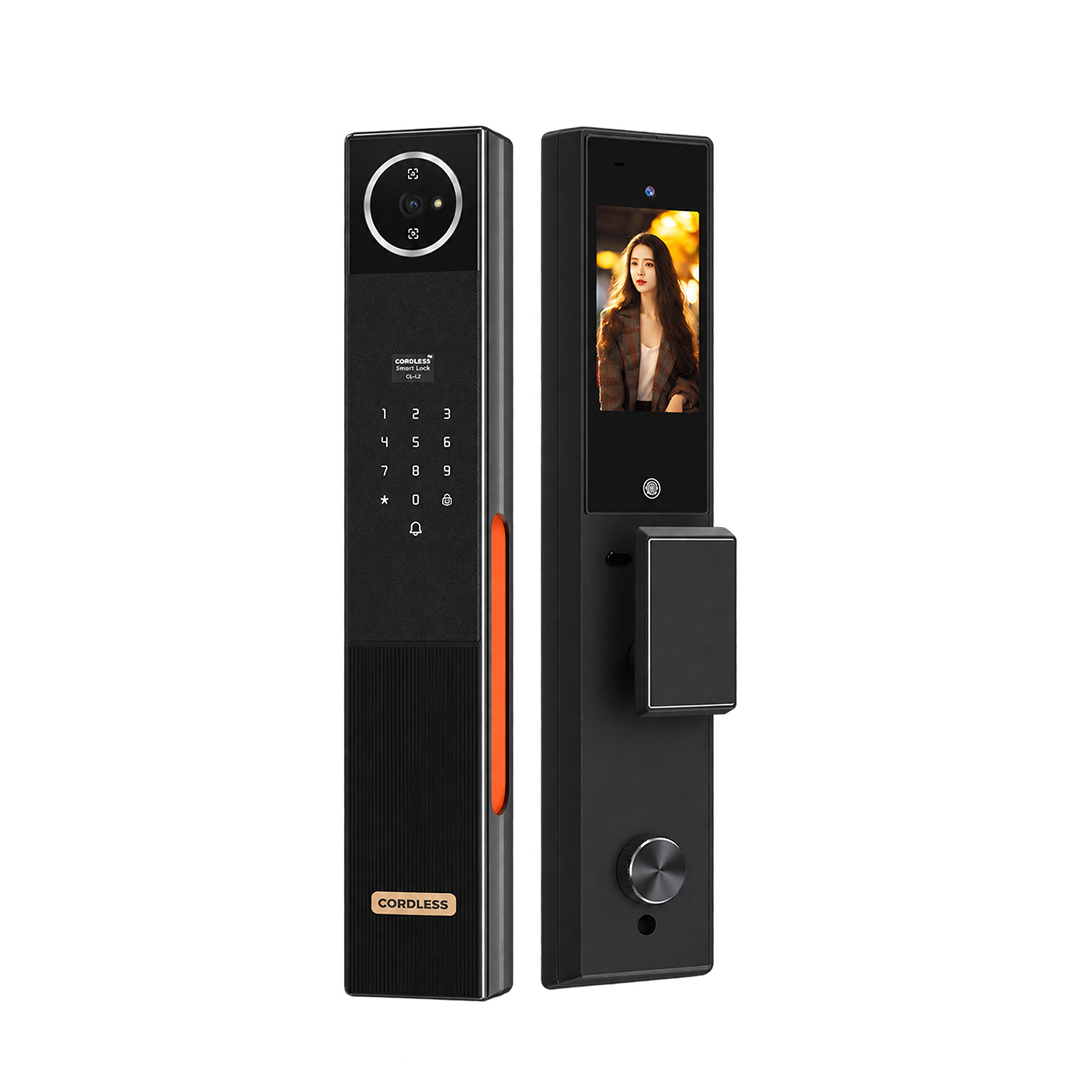
The CL-L2 uses 3D structured light face recognition, palm vein, front and rear cameras and a dual-battery system in a CNC-machined titanium-aluminum body. Listed price: 17,000 EGP.
Best Value With Face and Palm Vein: CL-07 and CL-08
If you want face recognition and palm vein at a more accessible price, the CL-08 (13,300 EGP) and the CL-07 (14,000 EGP) both offer face, palm vein, fingerprint, PIN, card, key and app access, with a built-in camera.
Apple Home Users: CL-03 (Matter)
The CL-03 Matter adds 3D face recognition and fingerprint with support for the Matter smart home standard, so it can work with Apple HomeKit. Listed price: 16,200 EGP.
Buying Checklist for a Face Recognition Door Lock
Use this checklist before you buy any face recognition door lock, from Cordless or anyone else:
- 3D, not 2D: confirm the lock uses 3D structured light or depth sensing with liveness detection.
- Second biometric: palm vein or fingerprint as a backup for twins, masks or low light.
- Backup access: PIN code, card and a mechanical key or emergency USB-C power port.
- Battery: rechargeable lithium battery with low-battery alerts in the app.
- Door compatibility: check that the lock body fits your door type and thickness (wooden, armored, aluminum or glass).
- App and ecosystem: Tuya Smart, Alexa or Matter support if you already have a smart home.
- Local warranty and support: buy from a company in Egypt that can install, service and supply spare parts.
If you are still deciding between brands and models, our guide to the best smart locks and our article on smart locks in Egypt give more background.
Is a Face Recognition Door Lock Safe for Privacy?
A common question is where your face data goes. In quality smart locks, face templates are stored locally in the lock’s encrypted memory and are used only for matching at the door. The app is used to manage users, view logs and receive alerts. As with any connected device, protect your account with a strong password, keep the app updated and only share access with people you trust.
You also stay in control: you can delete any registered face at any time, and you can disable face unlock completely and rely on palm vein, fingerprint or PIN if you prefer.
Frequently Asked Questions
Does a face recognition door lock work at night?
Yes. 3D models use infrared light, so they recognize faces in darkness or in a dim building corridor.
Can someone open it with my photo?
Not with a 3D face recognition door lock that has liveness detection. It measures depth, so a flat photo or video does not match.
What happens if the battery runs out?
You will receive low-battery warnings well in advance. In an emergency, you can use the mechanical key or power the lock through the emergency USB-C port on supported models.
Is palm vein better than face recognition?
Palm vein is slightly more secure because the pattern is under the skin, while face recognition is more convenient because it is completely hands-free. The best choice is a lock that offers both.
Will it fit my door?
Most Cordless face recognition models are designed for wooden and armored doors. For aluminum, iron or glass doors there are dedicated models. Contact our team with your door details and we will recommend the right fit.
Conclusion: Choose Convenience and Security Together
A face recognition door lock gives you the most effortless way to get home: no keys, no codes and no touching. Fingerprint locks remain a fast and affordable option, and palm vein recognition offers the highest level of biometric security. The smartest choice is not picking one, but choosing a lock that combines 3D face recognition with palm vein or fingerprint and reliable backup methods.
Explore the full range of Cordless smart locks, compare models, and contact our team if you would like help choosing the right face recognition door lock for your home in Egypt.